Total Pageviews

Saturday, August 29, 2009

August 29 :: Welcome back!

Greetings!

Welcome weekend is off to a swinging start (or a rainy, cold start, depending on how you look at it).

The plants and I are hopeful that this cold spell won't last for too long - i'm sure not ready to be done with summer and neither are the tomatoes and squash!

Here is an update on the tomatoes:

Most of the plants have both flowers and tiny tomatoes on them. In case you didn't know, tomato plants are easy to pollinate. Flies, bees, beetles and even wind can move pollen from one tiny yellow flower to another or within a flower. In the case of greenhouse tomatoes where none of those factors may be present, humans can hand-pollinate using a soft, small paint brush or simply apply a vibration like that of an insect's wings.

Two of our six heirloom tomato plants on the Brooks Student Center patio


New flowers, ready to be pollinated ( pictured below)! Unlike many flowers, tomato flowers have both the male (stamen) and female (pistil) parts of the flower closely held together instead of standing up separately of one another. The anthers, which create the pollen, have fused in a cone over the pistil, part of which will become the fruit. Therefore just a little vibration or shaking will get the anthers to release their pollen and it falls down in the cone onto the stigma, moves down through the style and into the ovary. Voila! Fertilization! Have more questions? Go here.
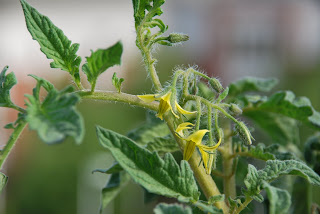
These tomato flowers (below) have been fertilized and their anther cone has started to shrivel up, as its job is now done. The plant stops sending nutrients to the flowers once they are fertilized and starts redirecting nutrients to the new baby tomatoes.
A tiny green fruit will appear inside the ring of outer petals and grow into a tomato. The fertilized flower will dry up and may never get dislodged from the fruit as the tomato grows, as in the photograph below.


Some flowers may never be fully pollinated, others might succumb to disease or pests, while others may be aborted by the plant if conditions are not ideal (aka too wet, too dry, too few nutrients). A flower might be fertilized but never create a mature fruit due to the same circumstances. Consistent temperatures and maximum sun exposure should keep anyone's tomato plants happy enough to bear plenty of fruit.

Our tomatoes have a way to go before they are ready to eat. How are yours doing?

Grow on,
your Tomato Teacher

Tuesday, August 18, 2009

August 18 :: Hello Basil

Welcome back,

Our herbs are doing well despite the heat. Making sure they don't dry out too much is definitely key in their success.

A few weeks after planting a whole bed of genovese basil seedlings, their leaves were ready to be harvested and put to use. As the plants grow, their bigger, older leaves are tougher and less desirable for culinary uses and their stems become too woody to chew. The smaller, newer leaves however, are great either used fresh with mozzarella cheese or delightfully mixed with pine nuts, parmesan, and olive oil to create a green pesto for use on pasta or sandwiches.

As i harvested i sorted out the flowers and older leaves, which aren't as good to eat and have a different flavor, from the new tender leaves.


About a third of the way through the harvest. Still tons to pick!


A whole dish tub of basil ready for use. Hooray!


I turned over the bed and left it for a week before transplanting more basil seedlings. (The metal bins under the tables are on wheels and hold extra soil.)


In a few weeks we'll have more basil as well as lettuce.

Fresh food is the best!

Grow on,
Your Healthy Harvester

Wednesday, August 12, 2009

August 12 :: Lettuce!

The lettuce is growing!

Three weeks ago I planted a leaf lettuce mix from Johnny's Seeds in one of our greenhouse beds. Here is a photo timeline to bring you up to speed on its progress. We are hoping to eat it in two to three weeks. YUM!

One week after seeds were planted:

Two weeks after seeds were planted, it is getting a little taller and a lot fuller. I photographed my finger to give you a sense of scale.
Three weeks after planting the leaves of lettuce are really starting to fill in.
Lettuce seeds for leafy lettuce have to be planted very shallow in the soil because they are so small and the seedlings so delicate. I may have covered these over a little too much in places, hence the gaps in the rows. The next crop will be perfect with everything i'm learning from this one!

Look for fresh, patio-grown lettuce in your salad bar soon.

Grow on,
Your Lettuce Lover

Wednesday, August 05, 2009

August 5 :: Who's blooming?

Hello summer! Finally some warmer, brighter days. The sun is good for people and plants alike.

Lots of things are blooming out in the raised beds. The sun has stimulated plants to put out flowers for the roving pollinators. I haven't seen too many bees up here on the patio but we do have flies, wasps, and some beetles doing the work.

Nasturtiums

Both the leaf and the flower are edible on these annuals. The flower has a spicy, radish-like flavor that adds a lovely peppery bite to a salad or can be used as a garnish. The nasturtiums are doing so well that i had to cut them back severely last week to make room for the growing squash. I harvested over 60 flowers and this week you'd never know - i hardly made a dent!


Impatiens

These low growers traditionally enjoy less sun but are happily blooming their little hearts out in the raised beds. The flowers of impatiens are edible by people and unfortunately they've become the target of Japanese Beetles. The beetles have left most of the other plants alone although i did shake a few off the basil growing in the greenhouse. One or two japanese beetles can eat their way through a few flowers and leaves a day. There are all sorts of 'solutions' available to rid your garden of the, but i still choose to practice the 'just flick it off' option. After all, they are just trying to get a decent meal!


Squash

Our other star bloomers are the acorn squash plants. They are responding to the sun and shooting out loads of flowers. Did you know that squash flowers are either male or female? The male flowers get sent out on long stems, farther away from the body of the plant to fertilize female flowers. The female flowers sprout from the center of the plant and, once fertilized, will show a little bulge in the stem behind the blossom. This is the actual squash and since they form close to the plant they are supported by other stems. AMAZING!

Also, did you know you can eat these flowers? Just pick them (preferably the males, otherwise you maybe sacrificing a future squash) right after they open, stuff them with something delicious (most recipes i have encountered recommend a soft cheese concoction with goat cheese or cream cheese plus herbs), twist the top closed, dip them in egg and flour and fry them on the stove. Many farmer's markets and stands will have these seasonal delicacies. Get them while they last!

Check out the second photo for a highly professional diagram displaying both male and female squash blossoms, PhotoShopped by yours truly.
Enjoy!


Enjoy the bounty and take advantage of what your local farmers are growing. It could be your newest favorite food!


Grow on,
your Garden Gatherer